

By Gaurav Shah, Managing Partner, Trident Renewables
Roughly 60 clean-hydrogen projects, more than 4.9 million tonnes a year of planned capacity, were cancelled in 2025. The technology did not stop working. The economics only ever closed on a single subsidy, the demand never showed up at the price, and OBBBA just lit a fuse under the subsidy. Here is the arithmetic a 2026 investment committee actually needs.
The 60-Project Reset
These were not fringe ventures. Air Products walked away from a multi-billion-dollar project; BP and Statkraft retrenched; S&P Global counts around 60 clean-hydrogen projects shelved in 2025. Every post-mortem lands on the same three causes: no bankable offtake, cost inflation through construction, and policy uncertainty. Two of those three are economic, and they are quantifiable. So let us quantify them, on June-2026 cost inputs rather than 2021 ambition.
The pattern has continued into 2026. In January, World Energy GH2 shelved its 1.2 GW green hydrogen and ammonia project in Newfoundland after failing to secure buyers for its output. In August 2026, Plug Power cancelled its planned plant at the Port of Antwerp, citing uncertainty about economic viability, and the US Department of Energy withdrew Plug Power’s $1.66 billion loan guarantee after the first drawdown deadline passed without any funds disbursed.
The 45V Credit Closes the Gap, Just Barely
We modelled the levelized cost of hydrogen for a realistic US green project on current inputs: 52 kWh/kg system efficiency, a $52/MWh firmed renewable PPA, $900/kW installed capex (electrolyzer system costs have fallen to roughly $700 to $1,000 per kW for PEM), and a 48% capacity factor. That builds to an LCOH of about $4.39/kg before subsidy, squarely inside the $4 to $7 per kg range the market reports for 2026. Grey hydrogen from steam-methane reforming runs around $1.50/kg.
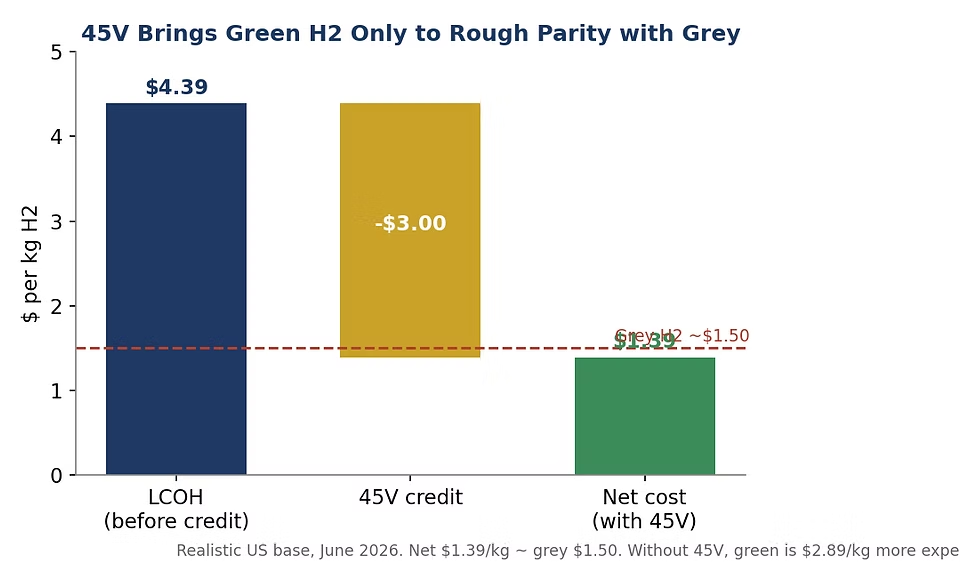
Apply the full $3.00/kg 45V Clean Hydrogen Production Credit and the net cost falls to about $1.39/kg, which is not a runaway win over grey, it is rough parity. Take the credit away and green hydrogen sits roughly $2.89/kg above grey. That single line item is the difference between a molecule that competes and one that does not. The entire US green-hydrogen investment case, stated plainly, is a bet that you can begin construction before the credit window closes and still hit parity, not advantage, with the incumbent.
The Credit Is Necessary, Not Sufficient
The headline parity number hides the harder truth. Power is 55 to 70% of LCOH, and power price and capacity factor are not independent levers you can each dial to best-case. Cheap unfirmed renewables deliver a low capacity factor; firming up to a high capacity factor raises the power price. So we modelled three coherent archetypes, with power, capacity factor and capex moving together as they do in the real world.

| Project archetype | Power ($/MWh) | Capacity factor | LCOH (pre-credit) | Net with 45V | vs grey $1.50 |
| Best case (cheap firmed power) | $35 | 55% | $3.25 | $0.25 | -$1.25 |
| Realistic US base | $52 | 48% | $4.39 | $1.39 | -$0.11 |
| Grid-exposed / strict hourly matching | $70 | 40% | $5.63 | $2.63 | +$1.13 |
Only the best case, cheap firmed power near $35/MWh at a 55% capacity factor, clears grey comfortably at $0.25/kg net of the credit. The realistic base lands at $1.39, parity. A grid-exposed project, or one whose capacity factor is dragged to 40% by strict hourly matching, lands at $2.63/kg even with the full credit, well above grey. This is precisely where the three-pillars rules bite: additionality and hourly temporal matching act directly on the two variables, power cost and capacity factor, that decide the outcome after the credit. A project that satisfies the pillars on paper but sheds ten points of capacity factor doing so can quietly price itself out while still technically qualifying.
Where the Three Cases Sit on Today’s US Power Map
The archetypes only help if they map onto real contract prices, so here is where they sit on current US data. LevelTen’s P25 index, the 25th-percentile offer price that serious buyers negotiate against, put unfirmed solar at about $49/MWh in ERCOT (Texas) at the end of 2025, the cheapest major US market. The same index showed $81/MWh in PJM, the mid-Atlantic grid that includes Virginia’s data center corridor, and $115/MWh in ISO New England. In the first quarter of 2026 the continental averages reached $64/MWh for solar and $79/MWh for wind, the highest since LevelTen began indexing in 2018. Solar eased slightly in the second quarter. Wind kept rising, with new-build wind largely stalled by federal permitting.
Three conclusions follow for a hydrogen developer:
First, the $35/MWh best case barely exists on the US contract market today. Even Texas solar, before any firming, is priced well above it. Reaching $35 firmed takes something the open market does not offer, such as owned generation built on older cost bases or a behind-the-meter hybrid on cheap land.
Second, location moves the cost of hydrogen more than any electrolyzer choice. At 52 kWh/kg, every $10/MWh adds about $0.52 to each kilogram. Holding capacity factor and capex at our base assumptions, the same plant costs roughly $4.23/kg on ERCOT solar pricing before firming costs, $5.90/kg on PJM pricing and $7.67/kg in New England. The 45V credit is worth the same $3.00 in each place, so only a Texas-style power price comes close to parity with grey.
Third, data centers now compete directly for the power electrolyzers need. Hyperscalers are signing PPAs in PJM and ERCOT at prices a hydrogen project cannot match, and wind, the better partner for a high capacity factor, is the tightest resource of all. A developer without contracted power is bidding against buyers with deeper pockets.
The Offtake Problem Nobody Solved
Even a project that clears on cost can die, and most of the cancelled pipeline died here. Green hydrogen has a demand problem that the production-cost debate tends to skip. The credible near-term offtakers, ammonia and refining, already buy grey hydrogen at $1.50/kg and have no mandate to pay a green premium. The aspirational offtakers, steel, shipping, heavy mobility, are years from contracting at volume and are themselves unsubsidised on the demand side. The result is a thin market of creditworthy buyers willing to sign a long-term, bankable, take-or-pay contract at a price that supports the project.
For a lender, the offtake is the asset. A letter of intent from a buyer who can walk is not financeable. This is why projects with attractive modelled LCOH still failed to reach financial close: the cost stack penciled, but no investment-grade counterparty would underwrite the revenue. For an investor, the diligence order is therefore inverted from the pitch, which is why a credible green hydrogen commercialization strategy has to start with bankable demand, not electrolyzer selection. Confirm the offtake is real and bankable first; the LCOH only matters if someone will buy the output at a price above it.
Blue Hydrogen Holds the Better Hand Under OBBBA
There is an allocation question hiding inside the policy. OBBBA accelerated the sunset of 45V, the green-hydrogen credit, but the 45Q credit for carbon capture, which underpins blue hydrogen (SMR with CCS), was treated far more favourably and runs on a longer horizon. For a decarbonised-hydrogen mandate, blue hydrogen therefore carries a more durable subsidy, an existing feedstock and process base, and a lower delivered cost today. Its weakness is upstream methane and capture-rate scrutiny, which is a measurement and operational problem rather than a fundamental cost gap.
The investor implication is uncomfortable for green purists. If the objective is low-carbon hydrogen molecules into existing industrial demand over the next five to seven years, blue hydrogen is, on current policy and cost, the more bankable bet in most US locations. Green hydrogen wins where cheap firmed renewables are genuinely abundant, where the buyer specifically requires zero-carbon rather than low-carbon hydrogen, or on a longer horizon as electrolyzer capex and renewable power continue down their cost curves. Treating green and blue as one trade is the error; they have different risk profiles, different policy exposure, and different time horizons.
Do Higher Gas Prices Tip the Scale Toward Green?
Grey and blue hydrogen are made from natural gas, so a fair question is whether rising US gas prices change the conclusion above. The arithmetic says they help green far less than most people assume.
Steam methane reforming uses roughly 0.16 MMBtu of gas per kilogram of hydrogen, so each $1/MMBtu rise in Henry Hub adds about $0.16 to a kilogram of grey or blue hydrogen. The EIA’s July outlook has Henry Hub averaging close to $3.60/MMBtu across 2026 and 2027, about 10% below its 2016 to 2025 average in real terms. For our unsubsidised base case at $4.39/kg to match grey, gas would need to rise by around $18/MMBtu, to above $20. Henry Hub has never sustained anything close to that. European buyers did face prices at that level and higher in 2022, which goes a long way to explaining why the hydrogen plans drawn up that year looked bankable then and do not today.
A less obvious effect matters more. In markets where gas plants set the marginal power price, which is much of the time in ERCOT and PJM, higher gas also raises wholesale electricity prices. A combined-cycle plant burns about 7 MMBtu per MWh, so a $1/MMBtu rise can lift marginal power by around $7/MWh. For a grid-exposed electrolyzer that adds roughly $0.36 per kilogram, more than twice what it adds to grey. Rising gas prices can therefore leave a grid-exposed green project further behind grey than before.
Where green does gain in a volatile gas market is price certainty. A project on a long-term, fixed-price renewable PPA produces hydrogen at a cost that does not move with gas, while grey and blue carry gas price risk for the life of any supply contract. For an ammonia or refining buyer who has lived through gas spikes, a fixed 15- or 20-year hydrogen price has real value, and it is a stronger commercial argument than a headline cost comparison. That advantage only exists if the power is contracted. Blue hydrogen, meanwhile, keeps the 45Q carbon capture credit, which is unaffected by gas prices, so a moderate rise in gas narrows blue’s lead without removing it.
The 2028 Cliff Changes the Question
Under the original rules, 45V covered facilities beginning construction through 2032. OBBBA moved that begin-construction deadline forward to 1 January 2028. A project that cannot break ground in roughly the next fifteen months does not lose a little credit value at the margin; it loses the entire $3/kg, which the model shows is the difference between $1.39 and $4.39 per kilogram. The question for a 2026 committee is therefore no longer “is green hydrogen competitive?” It is “can this specific project reach a financeable, shovel-ready state, with power and a bankable offtake locked, before the window shuts?” Most of the 60 cancelled projects could not answer yes to all of it.
What Still Clears an Investment Committee
The survivors share a recognisable profile. If a green-hydrogen project crossed our desk, this is what we would need to see:
- A bankable, investment-grade offtake. Take-or-pay, long-dated, a counterparty that cannot walk. This is the first test, not the last, because it is where the pipeline actually died.
- Groundbreaking before 1 January 2028. A credible construction-start plan, not an FID target. Model the economics with zero 45V; if nothing survives, the project is a policy bet on a closing window.
- Sub-$40/MWh firmed renewable power, contracted. Power is the majority of LCOH. Merchant grid exposure at $70/MWh loses even with the credit.
- A capacity factor that survives the three pillars. Model hourly matching and additionality honestly. If compliance drags the capacity factor toward 40%, the math stops working.
- Capex certainty. Electrolyzer and balance-of-plant pricing locked with contingency.
- An honest blue-vs-green test. If the buyer needs low-carbon rather than zero-carbon molecules, ask whether blue hydrogen clears the same job with more durable policy support.
How We’d Read the Opportunity
Stegra in Sweden shows what the survivors look like. Its 690 MW electrolyser feeds a hydrogen-based steel plant, and it signed offtake with Mercedes-Benz, Porsche, Scania and Volvo before reaching final investment decision. It closed a further €1.4 billion of financing in April 2026.
AM Green’s Kakinada project in India is the second example, and it answers the question US developers have struggled with most: how to run an electrolyzer at a high capacity factor on renewable power that also meets strict hourly matching rules.
AM Green took FID in August 2024 on a first phase of 1 million tonnes a year of green ammonia, using 1.3 GW of pressurised alkaline electrolyzers. Power comes from about 4.5 GW of solar and wind combined with 950 MW of pumped storage, shaped into roughly 1.3 GW of round-the-clock renewable supply. The electrolyzers are sized to that firmed supply, well below the peak output of the solar and wind farms, which is what lets them run almost continuously. A 25-year fixed-price PPA with NTPC covers about half of the round-the-clock requirement.
The design lines up with our checklist on three counts. Pumped storage turns intermittent generation into firm power, so the project was pre-certified under the EU’s renewable hydrogen rules, including additionality and hourly matching, without giving up capacity factor. It was built on an existing urea plant AM Green acquired, which brings ammonia synthesis, utilities and port access that a greenfield project has to build from scratch. And the buyers came early: offtake term sheets with Uniper and Yara were in place at FID, and Uniper has since signed a long-term agreement for up to 500,000 tonnes a year, with first shipment expected as early as 2028.
None of this relies on 45V. For US investors, the lesson is the order of decisions: firm the power with storage before sizing the electrolyzer, reuse existing ammonia infrastructure where it exists, and treat offtake as the gating item. The project has yet to prove itself at commercial scale, so its first years of operating data will be the real test.
Green hydrogen is not uninvestable. It is narrowly investable, on terms most of the 2025 pipeline could not meet: a real offtake, cheap firmed power, capex certainty, and a construction start inside the 45V window. The collapse of the speculative pipeline is the market pricing risk correctly for the first time, and a narrower field of genuinely bankable projects is a better hunting ground for disciplined capital than a crowded one full of letters of intent. The edge is not conviction in the molecule. It is the discipline to underwrite offtake and timing before cost, and to know when blue hydrogen is quietly the better trade.
This article was originally published on the official website of Trident Renewables and can be accessed here